
Nonstick cookware carries a reputation that most people can’t fully explain but somehow still trust. Maybe you’ve heard that Teflon pans are dangerous if scratched. Maybe you’ve seen “PFAS-free” on packaging and assumed it meant something specific, without knowing exactly what. Maybe you’ve just felt a low-grade unease every time you cook eggs in a nonstick pan, without being sure whether that unease is actually justified.
Part of the problem is that this topic has been talked about in extremes for a long time. Older warnings about Teflon still circulate, often without the context of what’s changed in manufacturing since. Newer ceramic coatings get marketed as the safe alternative, sometimes without explaining what they’re actually being compared to, or why. Somewhere between old fears and new marketing, it’s genuinely hard to find a straight answer.
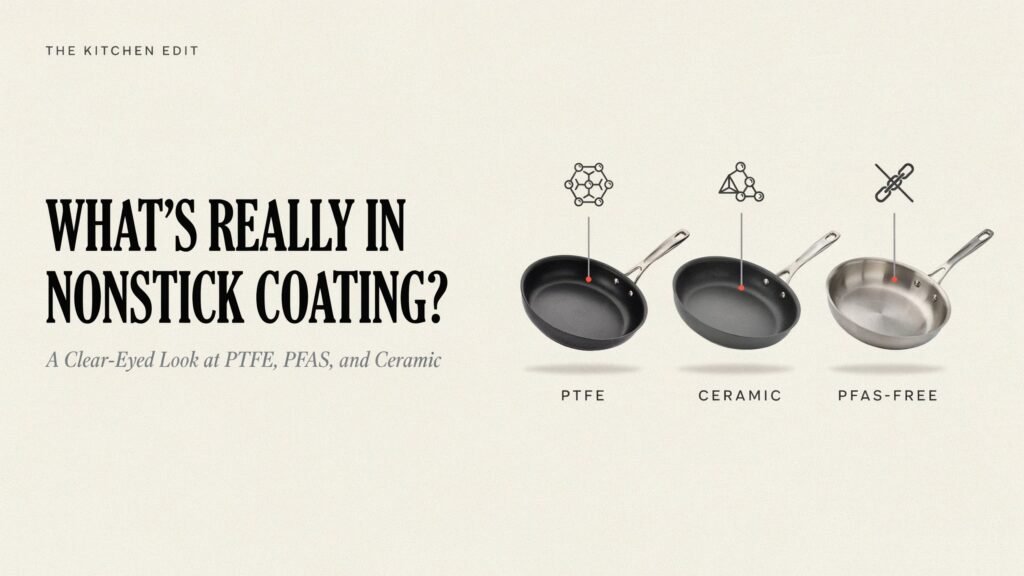
This isn’t going to be an article that tells you nonstick cookware is either perfectly fine or something to avoid entirely. It’s going to walk through what’s actually in these coatings, where real health concerns come from, where the concern gets overstated, and what meaningfully differs between PTFE and ceramic nonstick. The goal is to leave you with an accurate picture, so whatever you decide to cook with is based on facts instead of a vague sense of worry.
A Quick History: Why Nonstick Coating Has a Reputation Problem
To understand why nonstick cookware makes people uneasy, it helps to know where that unease actually started. Teflon, the brand name for PTFE coating, became the standard for nonstick cookware starting in the mid-20th century, and for decades it was simply the default choice with little controversy attached to it.
That changed in the early 2000s, when research began linking PFOA, a chemical that was used in the manufacturing process to help PTFE bond to cookware, to a range of health and environmental concerns. PFOA doesn’t break down easily in the environment or the body, and studies found it accumulating in water supplies, wildlife, and human blood, which eventually led to lawsuits, regulatory action, and a wave of public concern about nonstick cookware broadly.
That history is the real source of the fear that still surrounds nonstick pans today, and it’s a legitimate one — PFOA genuinely was a problem. What often gets lost is that the concern was specifically about PFOA, a manufacturing chemical, not about PTFE, the finished coating itself. Manufacturing has also changed significantly since then. But because “Teflon” and “nonstick” became associated with that controversy in the public mind, the caution has outlasted a lot of the manufacturing practices that originally caused it.
This history is part of why GreenPan exists in the first place. The brand was founded in 2007, specifically to offer a PFAS-free alternative to traditional nonstick coatings, at a time when this exact concern was becoming widely known. The next few sections break down what was actually true about that original concern, what’s changed, and what “PFAS-free” really means.
What PTFE Actually Is (And Isn’t)
PTFE, or polytetrafluoroethylene, is the polymer behind Teflon and most traditional nonstick coatings. Once it’s manufactured and applied to a pan, PTFE is a stable, inert material — it doesn’t react with food, doesn’t leach into what you’re cooking under normal conditions, and isn’t absorbed by the body the way some other chemicals are. Its molecular structure is dense and tightly bonded, which is part of why it works so well as a nonstick surface in the first place: very few things stick to it, including, under ordinary use, anything harmful.
This is the point that gets lost in a lot of nonstick cookware anxiety. The concern that made headlines in the early 2000s wasn’t actually about PTFE itself. It was about PFOA, perfluorooctanoic acid, a separate chemical that was used as a processing aid to help PTFE adhere evenly to cookware during manufacturing. PFOA was the substance linked to health and environmental harm, not the finished PTFE coating sitting on your pan.
That distinction matters because PFOA has been phased out of PTFE cookware manufacturing in the United States since 2013, following a voluntary phase-out agreement between the EPA and major manufacturers. Cookware made after that point, using modern manufacturing processes, doesn’t rely on PFOA at all. So while it’s accurate to say PFOA was a real and serious concern, it’s not accurate to treat that concern as still describing how PTFE cookware is made today.
None of this means PTFE is beyond scrutiny — the next section covers where a legitimate concern still exists. But the specific fear most people have heard about, tied to PFOA, is largely a description of cookware manufacturing from decades ago rather than current practice.
What “PFAS” Means, and Why It’s a Broader Category Than People Think
“PFAS” gets used constantly in cookware marketing and news coverage, often as shorthand for “bad chemical,” without much explanation of what the term actually covers. That vagueness is part of why it functions so well as a scare word, and part of why it’s worth understanding more precisely.
PFAS stands for per- and polyfluoroalkyl substances, and it’s not one chemical — it’s a category that includes thousands of different compounds, all sharing a similar carbon-fluorine chemical bond. PFOA, the chemical responsible for the original Teflon controversy, is one member of this category. PTFE, the finished nonstick coating, is technically also classified as a PFAS compound, because of its chemical structure, even though it behaves very differently from PFOA in practice.
This is where a lot of nuance gets flattened. Some PFAS chemicals, including PFOA, are small, mobile molecules that can enter water systems, accumulate in the body, and have been linked to genuine health concerns. PTFE, by contrast, is a large, stable polymer that doesn’t break down or migrate the same way, which is why many toxicologists draw a meaningful distinction between PTFE’s structural stability and the risks associated with smaller, more mobile PFAS chemicals like PFOA. Lumping every compound with a similar bond into one alarming category, without distinguishing between them, oversimplifies a genuinely complicated area of chemistry.
None of this is an argument that concern about PFAS as a category is unfounded — some of these chemicals are a real environmental and health issue, and that’s precisely why regulation in this space keeps evolving. It’s simply worth knowing that “contains PFAS” and “poses the same risk as PFOA” aren’t automatically the same statement, even though they often get treated that way in casual conversation.
When PTFE Coating Actually Becomes a Concern
There is one legitimate, well-documented risk associated with PTFE cookware, and it’s worth being specific about it rather than either dismissing it or overstating it. When PTFE is heated to extremely high temperatures, well beyond anything involved in normal cooking, it can break down and release fumes. These fumes are known to be highly toxic to birds, and there’s evidence they can cause temporary flu-like symptoms in humans, sometimes referred to as “polymer fume fever,” in cases of significant exposure.
The key detail is the temperature required for this to happen. PTFE typically begins to degrade meaningfully around 500°F (260°C) and above, with more serious breakdown occurring at higher temperatures still. That range is well past what most home cooking involves. A pan left empty and unattended on high heat for an extended period can reach these temperatures, but actively cooking food, even at high heat, rarely does, since the food itself, along with any oil or liquid in the pan, keeps the surface well below the danger threshold.
In practice, this means the real-world risk comes down to a specific, avoidable scenario: an empty nonstick pan, forgotten on a burner, heating far past the point where food would normally be added. Standard cooking practices — adding food or oil before the pan gets dangerously hot, and not leaving an empty pan unattended on high heat — keep PTFE cookware well within its safe operating range for the vast majority of home cooks.
This is a real risk, and it’s worth taking seriously in the specific situation where it applies. But it’s a narrower and more avoidable risk than the general unease around nonstick cookware usually suggests.
Ceramic Nonstick: What It Is and How It’s Different
Ceramic nonstick coating isn’t a variation on PTFE — it’s a fundamentally different material, built from a different chemistry entirely. Rather than being derived from fluoropolymers, ceramic coatings are typically made from silica, essentially sand, that’s processed into a smooth, glass-like nonstick surface. Because the underlying chemistry doesn’t involve carbon-fluorine bonds at all, ceramic coatings are genuinely free of PFAS compounds, not just free of the specific chemicals that caused concern with older PTFE manufacturing.
This is a meaningful distinction, not just a marketing one. Where PTFE cookware requires understanding the PFOA history and drawing a line between the coating and older manufacturing chemicals, ceramic coating sidesteps that conversation entirely, since there’s no PFAS-related compound in the material to begin with. For anyone who’d rather not think about PFAS at all when it comes to their cookware, ceramic offers a straightforward way to do that.
Ceramic isn’t without trade-offs, though. Generally speaking, ceramic nonstick coatings tend to lose their nonstick performance somewhat faster over time than PTFE, particularly with high heat, metal utensils, or dishwasher use. This doesn’t make ceramic a lesser choice, but it does mean the same care habits that extend any nonstick pan’s life — gentle utensils, moderate heat, hand washing — matter just as much, if not more, with ceramic coatings.
GreenPan’s Thermolon coating, used across collections like Valencia Pro and Spectra, is a ceramic nonstick coating built around this exact idea — sand-derived, PFAS-free, and designed to deliver strong nonstick performance without the fluoropolymer chemistry that PTFE relies on. For anyone curious about the specifics of how it’s made, the technology page goes into more detail than fits here.
So, Should You Worry?
Based on current regulatory and scientific consensus, modern PTFE cookware, manufactured without PFOA and used at normal cooking temperatures, is considered safe. Regulatory bodies including the FDA have approved PTFE for cookware use, and the specific risk that made headlines decades ago was tied to a manufacturing chemical that’s no longer part of the process. For most people cooking under normal conditions, the evidence doesn’t support significant concern about PTFE nonstick pans made after the 2013 phase-out.
That said, “considered safe under normal use” isn’t the same as “risk-free under all circumstances,” and it’s reasonable for that distinction to matter to some people more than others. If the idea of any PFAS-classified material in your cookware doesn’t sit well with you, even when that material is PTFE rather than PFOA, that’s a legitimate personal line to draw, not something that requires disputing the underlying science. Preferences don’t have to be justified purely by risk calculations.
This is where ceramic nonstick earns its place, not as a correction to PTFE being unsafe, but as a genuine, PFAS-free alternative for people who’d rather avoid the category altogether. Choosing ceramic isn’t about fixing a flaw in PTFE cookware. It’s about a different set of priorities, and both are reasonable starting points depending on what matters most to you.
For a closer look at how GreenPan specifically addresses these questions, including testing and certifications, the safety of our product page covers this in more depth than a general overview like this one can.
Closing
Once the history, the chemistry, and the actual risks are separated from the reputation, nonstick cookware turns out to be a less alarming topic than it’s often made out to be. Modern PTFE, made without PFOA, is considered safe for normal cooking. Ceramic nonstick sidesteps the PFAS conversation entirely, at the cost of somewhat shorter coating life. Neither one is the “correct” choice in some universal sense. They’re just two different materials with different trade-offs, and which one fits depends more on personal preference than on one being objectively dangerous and the other objectively safe.
What matters most is making that choice with accurate information instead of secondhand fear or vague marketing claims. If PFAS-free is a priority for you regardless of how PTFE’s safety profile is explained, ceramic is a legitimate, well-reasoned choice, not an overcautious one. If you’re comfortable with modern PTFE cookware once you understand the PFOA distinction, that’s an equally reasonable position to land on.
For anyone who’s decided ceramic is the right fit, the collection comparison guide is a useful next step for finding the specific collection that matches how you cook.