You pull a pan out of the cabinet and pause. The nonstick surface looks a little duller than it used to. There’s a faint scratch near the edge. It still cooks fine, mostly, but a small part of you wonders if you should have replaced it already, or if you’re being paranoid and it’s got years left in it.
This is a surprisingly common moment, and most people don’t have a clear answer to it. Cookware doesn’t come with an expiration date, and advice online tends to be vague — “replace nonstick every few years” gets repeated a lot, but nobody explains why, or what that means for a stainless pot that’s been in the family for two decades, or a cast iron skillet that’s older than the person cooking with it.
The truth is that lifespan depends almost entirely on what the pan is made of. Some materials wear down in predictable, specific ways, and knowing what those signs look like tells you far more than counting years ever could. Others barely wear down at all under normal use, and holding onto them for decades isn’t optimism, it’s just accurate. Below is a breakdown by material, with the actual signs to look for so you’re not guessing.
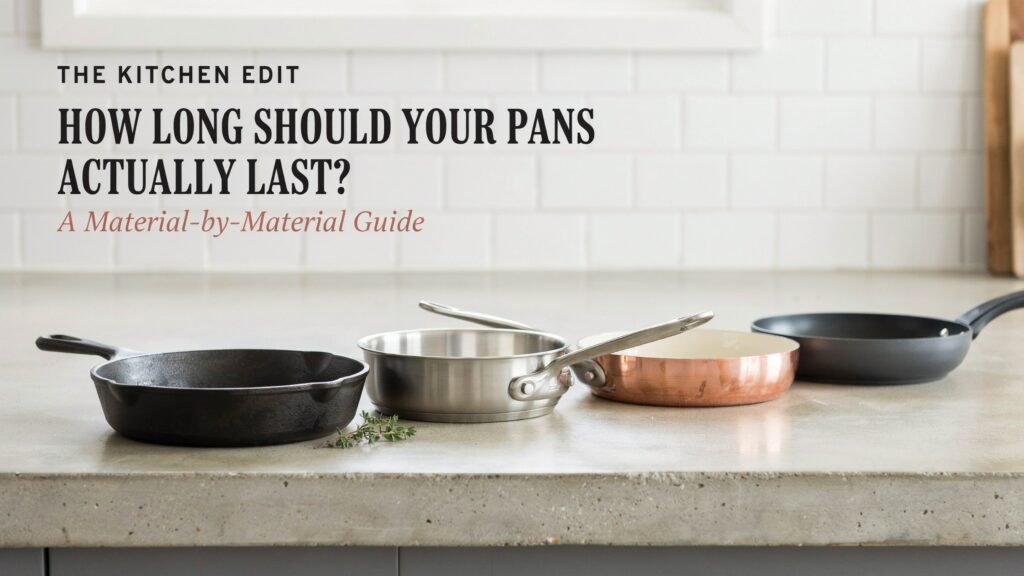
Why “How Long Does Cookware Last” Doesn’t Have One Answer
The reason this question feels hard to answer is that it’s really several different questions wearing one trench coat. A nonstick skillet, a stainless steel saucepan, and a cast iron pan don’t fail the same way, don’t fail for the same reasons, and don’t fail on anything close to the same timeline. Treating them as one category is what makes the whole topic feel murky.
Material is the biggest factor. Some cookware, like nonstick and ceramic-coated pans, has a surface layer that gradually wears down no matter how carefully it’s used. Once that layer is gone, the pan doesn’t perform the way it used to, even if the rest of it is perfectly intact. Other cookware, like stainless steel or cast iron, has no coating to lose in the first place. Barring damage, there’s no built-in clock counting down.
How the pan gets used matters just as much. A pan that gets used daily on high heat wears differently than one used a couple of times a week on medium. Metal utensils, dishwashing, stacking without protection, and thermal shock from things like running a hot pan under cold water all accelerate wear regardless of material. Two identical pans can have very different lifespans depending on how they’re treated.
That’s why the rest of this guide is broken down by material instead of giving one blanket number. A realistic timeline, paired with the specific signs of wear to watch for, is far more useful than “replace every X years” — because for some materials, that number barely applies at all.
Nonstick and Ceramic Nonstick: Usually 3–5 Years
Nonstick cookware has the shortest realistic lifespan of any cookware type, and that’s true no matter how well-made the pan is. The nonstick surface, whether it’s traditional PTFE or a ceramic coating, is a layer applied on top of the base metal. Layers wear down. That’s not a defect, it’s just how the category works, and it’s worth knowing going in rather than being surprised by it a few years later.
A few things speed up that wear. Metal utensils scratch the surface even when the scratches aren’t visible right away. High heat degrades some coatings faster than gentle, moderate cooking does. Dishwashing wears down coatings faster than hand washing, especially with harsh detergents. And stacking nonstick pans without anything between them causes fine scratching that adds up over time.
The good news is that not all nonstick coatings age the same way. Ceramic nonstick, like GreenPan’s Thermolon coating used across the Valencia Pro and Spectra collections, tends to hold up longer than traditional PTFE nonstick when it’s cared for properly, and it’s PFAS-free from the start rather than something to worry about as it wears. The care and use guide covers the specifics, but the short version is: gentle utensils, hand washing when possible, and moderate heat all go a long way toward getting the most out of a coating.
Even with good care, though, there’s a real end point. If food starts sticking more than it used to, or the surface looks dull, patchy, or visibly scratched, that’s the coating telling you it’s worn past the point where technique can compensate. At that point, replacing it is the right call rather than a failure of care.
Stainless Steel: 10+ Years, Sometimes a Lifetime
Stainless steel is the outlier on this list, in a good way. There’s no coating to wear out, no seasoning to maintain, and no surface layer with a built-in shelf life. Barring damage, a well-made stainless steel pan can realistically outlast the person who bought it, and it’s common for people to still be cooking with pieces they’ve had for fifteen or twenty years without any real drop in performance.
That doesn’t mean stainless steel is indestructible, just that what actually causes problems is different from what people expect. Discoloration, minor scratching, or a slightly dulled surface are cosmetic and don’t affect how the pan cooks. What does matter is structural: warping that makes the pan rock instead of sitting flat, rivets that have loosened and let the handle wobble, or a base that’s separated or bulged so the pan no longer makes even contact with the burner. Those issues affect how heat distributes across the surface, which is the one thing that genuinely impacts cooking performance.
Warping usually comes from thermal shock — heating an empty pan too aggressively, or plunging a hot pan into cold water. Avoiding both of those is most of what it takes to keep a stainless pan performing well for decades.
Because stainless steel is meant to be a long-term piece of cookware rather than something replaced every few years, it’s worth choosing something built for daily, sustained use from the start. The Stanley Tucci 3-ply stainless steel collection is designed with exactly that kind of longevity in mind — cookware meant to be a fixture in the kitchen rather than something cycled through.
Cast Iron and Carbon Steel: Decades, With Maintenance
Cast iron and carbon steel are built to last longer than almost anything else in the kitchen, and a lot of what looks like damage on these pans isn’t actually permanent. Rust, a dull or patchy surface, and even a pan that’s been badly neglected for years can usually be brought back with some cleaning and re-seasoning. This surprises people who assume rust or stickiness means a pan is done, when in most cases it just means the seasoning layer needs to be rebuilt.
Seasoning is a layer of polymerized oil baked into the surface of the metal, and it’s what gives these pans their natural release. Unlike a factory nonstick coating, it’s not something that permanently wears away — it’s something you maintain, and it can be stripped down and rebuilt as many times as needed without hurting the pan underneath. That’s a big part of why cast iron and carbon steel pans regularly get passed down between generations and still cook well decades later.
Real, non-reversible damage is rare with these materials, but it does happen. A crack in the metal, severe warping from extreme or uneven heat, or a handle that’s structurally failed are the situations that actually call for replacement rather than restoration. Short of that, almost anything else — rust, stickiness, a rough or uneven surface — is a maintenance issue, not a lifespan issue.
For anyone starting fresh or replacing a pan that’s genuinely beyond saving, pre-seasoned cast iron comes ready to cook with right away, and carbon steel frypans offer similar longevity in a lighter, faster-heating pan. Either one is a genuine long-term investment rather than something to expect to replace on any regular schedule.
Hard-Anodized and Enameled Cookware: 5–10 Years
Hard-anodized aluminum and enameled cast iron sit in between the extremes of nonstick and stainless steel. Neither wears out as fast as a nonstick coating, but neither is quite as close to permanent as bare stainless or cast iron either. With reasonable care, both categories typically hold up well for five to ten years, sometimes longer.
Hard-anodized cookware goes through an electrochemical process that hardens the aluminum surface, making it more scratch-resistant and durable than regular aluminum. It holds up well over time, but it can still show gradual wear — the surface may dull slightly, and if the pan has a nonstick layer on top of the anodized base, that layer will wear down on its own timeline, separate from the anodized aluminum underneath. It’s worth knowing which type of wear you’re looking at, since one is cosmetic and the other affects performance.
Enameled cookware, most commonly enameled cast iron, holds up differently. The enamel coating is glass-like and doesn’t degrade with normal cooking, but it can chip if the pan is dropped, knocked against something hard, or exposed to sudden temperature swings. A small chip is usually cosmetic and not urgent, but a larger crack or chip that exposes the cast iron underneath is a sign it’s time to consider replacing the piece, since that exposed area can rust and affect how the pan performs.
For enameled cookware specifically, Merten & Storck, GreenPan’s sister brand, is a good example of the category — enameled cast iron designed for everyday use rather than just occasional cooking, which makes it a reasonable long-term option as long as it’s handled with the same care any enameled piece requires.
Signs It’s Time to Replace, Regardless of Material
Some warning signs matter no matter what a pan is made of. These are the ones worth checking for across any type of cookware, since they affect either safety or basic performance rather than being cosmetic:
Warping that causes uneven heating. If a pan no longer sits flat on the burner, or you can see light under one side when it’s set on a flat surface, heat is no longer distributing evenly across the cooking surface. This affects how food cooks regardless of material.
Wobbling on the stovetop. A pan that rocks instead of sitting stable is usually warped or has an uneven base. Beyond being annoying to cook with, it’s a sign the base has changed shape in a way that isn’t going to fix itself.
Damaged or loose handles. A handle that wobbles, has cracked, or has loosened from the body of the pan is a safety issue, not a cosmetic one. This is worth addressing immediately rather than waiting, since a failing handle can let go while the pan is in use.
Coating that flakes into food. Any pan with a coating — nonstick, ceramic, or enamel — that’s started flaking or peeling should be retired right away. Flaking is different from ordinary wear or dulling; it means the coating is physically breaking down and pieces of it can end up in food.
A base that’s separated from the pan. This shows up mostly in multi-layer or clad cookware, where the layers are bonded together. If the base has started to separate, bulge, or come apart from the rest of the pan, that’s a structural failure rather than surface wear, and it won’t heat evenly or safely from that point on.
If a pan shows any of these signs, the material it’s made from doesn’t really matter — these all point to genuine replacement, not something to manage around with extra care.
How to Make Cookware Last Longer
Most of what shortens cookware’s lifespan comes down to a handful of habits, and adjusting them makes a real difference regardless of material.
Use the right utensils. Metal utensils scratch nonstick and ceramic coatings, and over time those scratches add up even if they’re not visible right away. Wood, silicone, or nylon utensils avoid this entirely. A set of silicone utensils is an easy way to make sure this isn’t a habit that’s quietly working against a pan’s coating.
Hand wash when it matters. Dishwashers are convenient, but harsh detergents and high heat wear down coatings faster than hand washing does. This matters most for nonstick and ceramic pans — stainless, cast iron, and carbon steel are more forgiving, though cast iron and carbon steel generally shouldn’t go in the dishwasher at all, since it strips seasoning.
Avoid thermal shock. Sudden temperature changes, like running a hot pan under cold water or setting a cold pan straight onto high heat, can cause warping over time, particularly in stainless steel and cast iron. Letting a pan cool naturally, and heating gradually rather than starting on the highest setting, protects the base from this kind of stress.
Store pans so they don’t scratch each other. Stacking pans directly on top of one another causes fine scratching that adds up, especially with coated surfaces. Pan protectors placed between stacked pans are a small habit that meaningfully extends coating life, and a proper cookware rack solves the same problem for anyone with the cabinet space.
Match heat to the pan. Higher heat than a pan is meant for accelerates wear across almost every material, but it’s especially hard on nonstick coatings. Most cooking, including searing, doesn’t actually need the highest setting on the stove — medium-high is usually enough, and it’s gentler on cookware over the long run.
None of these habits are complicated, and none of them require buying anything new. They just shift cookware from “wearing out faster than it has to” to “lasting as long as the material actually allows” — which, especially for stainless steel or cast iron, can mean decades instead of years.
Closing
Most cookware lasts longer than people give it credit for. A stainless pot doesn’t need to be replaced just because it’s old, and a cast iron pan with rust or a dull surface usually just needs some care, not a trip to the trash. The materials that actually have a real lifespan — nonstick coatings especially — wear out for specific, identifiable reasons, and knowing those reasons is far more useful than guessing based on age alone.
The pattern that matters most is this: cosmetic wear is rarely a reason to replace something, but structural or safety issues — warping, a wobbling handle, flaking coating, a separated base — are worth acting on right away. Once a pan crosses that line, no amount of careful use brings it back.
If a pan has genuinely reached the end of its life, the recycling program is a responsible way to retire it rather than sending it to a landfill. And for anyone replacing a piece or building out a kitchen with longevity in mind from the start, the product finder quiz is a quick way to match materials to how you actually cook, so the next pan lasts as long as it reasonably should.