
You’re browsing for cookware and a set catches your eye. Ten, twelve, sometimes nineteen pieces, all for less than what a few individual pans would cost on their own. It looks like the obvious choice — more pans, lower price per piece, and everything matches. You add it to the cart, feeling like you just found a good deal.
Then, a year later, half the pieces are still sitting in the cabinet, barely touched. Maybe it’s the small saucepan you never quite found a use for, or a second frypan in a size you already had covered, or a lid that doesn’t even match anything else in your kitchen anymore. The set that looked like such obvious value on paper turns out to be a lot of paying for pieces that never left the shelf.
This isn’t really about sets being a bad idea. It’s about a specific kind of math that’s easy to miss in the moment: a lower price per piece only matters if you’re actually going to use those pieces. If a chunk of the set goes unused, the “discount” you thought you got isn’t really a discount at all — it’s money spent on cookware that just takes up cabinet space. This piece breaks down when a set is genuinely worth it, when buying individual pans saves more money in practice, and how to tell which situation you’re actually in before you buy.
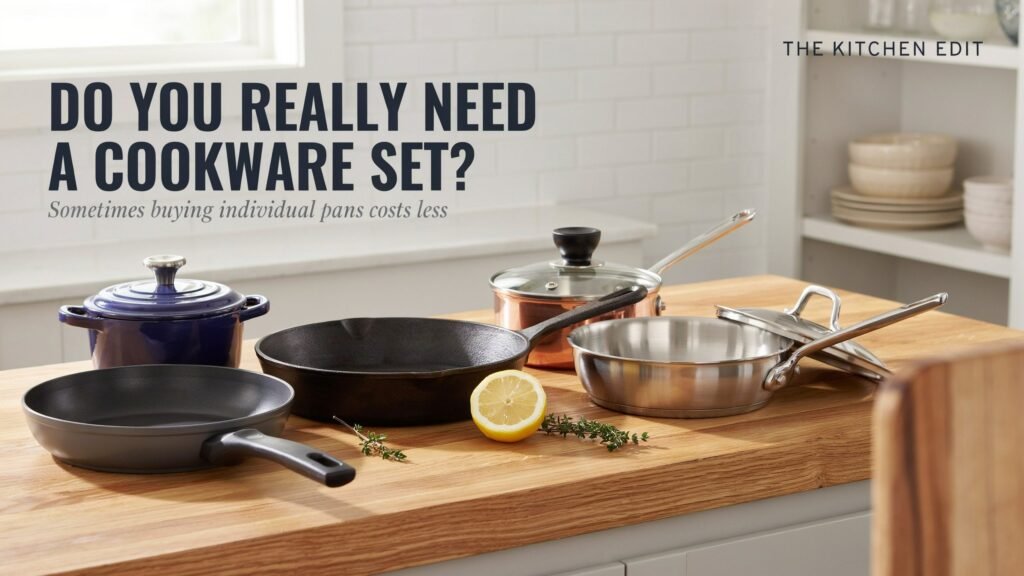
How Cookware Sets Are Priced (And Why They Look Like Such a Deal)
The math behind cookware sets is straightforward from a retail standpoint. It’s cheaper for a brand to package and ship several pieces together than to sell them one at a time, and bundling moves more inventory in a single sale. Both of those savings usually get passed on, at least in part, in the form of a lower price per piece compared to buying each item separately. That’s the reason a 12-piece set can look like it costs less than three or four individual pans would.
That discount is real. If you compared buying, say, a frypan, a saucepan, and a stockpot separately against buying a set that includes all three plus more, the set frequently comes out cheaper on paper. This is exactly why sets get marketed so heavily around value — the per-piece savings are genuinely there, and it’s not a trick or an illusion.
The part that gets lost is that the discount only applies to pieces you were actually going to buy anyway. If a set includes eight pieces and you’d have only bought four of them individually, you’re not saving money on the other four. You’re spending money on them. The lower price per piece is real, but it’s easy to mentally apply that discount to the whole set, when it should really only count for the portion you’d have purchased regardless.
That distinction is the whole reason this topic is worth thinking through before buying, and it’s what the rest of this piece walks through in more detail.
What’s Actually in Most Sets (And What Sits Unused)
Most cookware sets follow a fairly predictable pattern, and it’s worth knowing what that pattern looks like before assuming every piece will earn its place in your rotation. A typical mid-sized set includes two or three frypans in different sizes, one or two saucepans, a larger stockpot or Dutch oven, several lids, and sometimes an extra piece like a steamer insert or a small egg pan. Larger sets, like a 19-piece collection, add even more variety on top of that.
Some of these pieces get used constantly. A medium frypan and a mid-sized saucepan tend to be the workhorses of almost any kitchen, showing up in daily cooking regardless of what else is in the set. Those are the pieces where the per-piece discount genuinely pays off, because they’d have been bought either way.
Other pieces tend to sit untouched. A second or third frypan in a size that’s close to one you already have often goes unused, since most people gravitate toward one or two go-to sizes and rarely rotate through several similar ones. Extra lids are another common culprit — sets frequently include more lids than pots, and the spares end up loose in a drawer, functionally unused. Specialty pieces, like a small egg pan or a steamer insert, are useful for a narrow purpose and can go months without touching a burner if that particular dish isn’t part of your regular cooking.
Looking at something like the Valencia Pro 19-piece set makes this easy to see in practice. It includes a strong core of frypans and saucepans that most people will genuinely use often, alongside additional pieces, lids, and sizes that some households will use regularly and others may rarely touch. Neither is wrong, but it’s worth going in with a realistic sense of which category you fall into, since it changes whether the set’s per-piece price is actually working in your favor.
The Real Cost-Per-Use Math
Once you know which pieces in a set actually get used, the real value of that set becomes a lot clearer, and it’s a different number than the one on the price tag. The sticker price divides evenly across every piece, but the pieces you actually cook with are doing all the work, and that changes what the set effectively costs.
Here’s a simple way to see it. Say a 10-piece set costs $300, working out to $30 per piece on paper. If only five of those pieces get regular use, the other five are effectively costing money for cabinet space rather than cooking. The real cost of the pieces you actually use is closer to $60 each, not $30, because the $300 is split evenly across usage that isn’t actually even.
Compare that to buying four or five individual pieces you know you’ll use — even at a higher per-piece price than the set offered, the total spent on cookware that ends up in your regular rotation can come out lower. A $70 frypan and a $60 saucepan bought individually, both used weekly, can be a better outcome than a $300 set with five pieces gathering dust.
This math isn’t an argument against sets — plenty of people do use most of what comes in one, and for them the discounted per-piece price is a genuine win. It’s a way of checking, honestly, whether a specific set is likely to be that kind of win for you, or whether it’s likely to leave you paying full price, spread thin, for pieces that were never going to see regular use in the first place.
When a Set Actually Makes Sense
None of this means sets are a bad choice — for the right situation, they’re genuinely the smarter buy. Knowing when that’s true is just as useful as knowing when it isn’t.
Setting up a kitchen for the first time is one of the clearest cases. When you don’t own any cookware yet, there’s no existing collection to check against, and a wider range of pieces is more likely to get used simply because everything is new territory. A set covers the basics in one purchase, which is hard to beat for convenience when you’re starting from zero.
Sets also make sense as gifts, for similar reasons. It’s difficult to know exactly which individual pans someone already owns or prefers, so a well-rounded set is a safer choice than guessing at specific pieces, and it gives the recipient a solid foundation to build from.
And for people who genuinely cook a wide variety of dishes — someone who sears, simmers, sautés, and bakes on a regular basis — a larger set is more likely to get fully used than it would for someone with a narrower cooking routine. In that case, the range of pieces isn’t excess, it’s exactly what regular use calls for.
For any of these situations, it’s worth looking at a set sized to match, rather than defaulting to the largest one available. Something like the Valencia Pro 8″, 9.5″, and 11″ frypan set is a good example of a smaller, more focused set — three genuinely useful, commonly reached-for sizes, without the extra pieces that tend to go unused in a larger 15- or 19-piece collection. Matching the size of the set to how much variety you’ll actually use is often more important than matching it to the biggest available discount.
When Buying Individual Pieces Makes More Sense
Buying piece by piece tends to be the better route in a few specific situations, and they’re worth recognizing before defaulting to a set out of habit.
The most common one is already owning some cookware and just needing to fill in gaps. If you’ve already got a reliable frypan and a stockpot, buying a full set to get one new saucepan means paying for eight or nine pieces you don’t need in order to get the one you do. Buying that single saucepan directly gets you what’s actually missing without the extra cost layered on top.
Knowing your own cooking habits well is another good reason to buy individually. Some people have cooked long enough to know exactly which pan sizes and types they reach for — a 10-inch frypan and a 3-quart saucepan, say, with everything else rarely touched. For that kind of cook, a set is mostly padding around the two or three pieces that matter, and buying just those pieces is both cheaper and more deliberate.
There’s also a quality argument worth considering. Some sets balance cost by using a mix of construction quality across pieces — a sturdier frypan paired with thinner, less substantial saucepans, for instance. Buying individually means you can choose full quality on every piece you actually add to your kitchen, rather than accepting a mixed bag in exchange for a lower average price.
For any of these cases, shopping frypans, saucepans, or Dutch ovens individually makes it possible to fill a specific, known gap — the exact size or type that’s missing — without paying for a wider collection built around pieces you’d likely set aside.
How to Decide: A Few Questions to Ask Before Buying
Before buying either a set or a batch of individual pieces, a few honest questions make the decision a lot clearer than comparing prices alone.
What do I already own? If you’re starting from nothing, a set has more room to make sense. If you already have working pans covering some of what a set includes, it’s worth counting how much of the set would actually be new to your kitchen versus duplicating what you’ve already got.
What do I actually cook regularly? Think through a normal week or two of meals rather than what you might cook someday. If most of your cooking centers on two or three techniques — searing, simmering, maybe baking — that points toward a smaller, more targeted purchase rather than a set built for a wider range of cooking.
Am I buying for variety, or for pieces I’ll use weekly? It’s easy to be drawn in by the range a large set offers, even if most of that range won’t get touched often. Being honest about which pieces would realistically become part of a weekly routine, versus which ones sound useful but probably won’t be, changes the math considerably.
Would I buy each piece separately at this price? This is the most direct test. Look at the set’s per-piece price and ask whether you’d pay that for each individual item on its own. If the answer is yes across most of the pieces, the set is likely a good deal. If the answer is no for several of them, that’s a sign the set’s value is inflated by pieces you wouldn’t otherwise choose.
For anyone who wants a more structured way to work through this, the product finder quiz asks a short series of questions about cooking habits and kitchen needs, and points toward collections and pieces that actually match the answers, rather than defaulting to the largest set available.
A Reasonable Starter Collection (If Buying Piece by Piece)
For anyone building a kitchen from individual pieces rather than a set, it doesn’t take much to cover the vast majority of everyday cooking. A genuinely useful starting collection is smaller than most sets suggest, and it’s worth resisting the urge to buy more just because a wider range is available.
One versatile frypan, around 10 inches. This single pan covers eggs, sautéing vegetables, cooking proteins, and most stovetop meals for one or two people. A 10-inch frypan is large enough to be genuinely useful without being unwieldy for smaller, everyday cooking.
One mid-sized saucepan, around 2 to 3 quarts. This handles sauces, grains, reheating, and small-batch cooking that a frypan isn’t suited for. A saucepan in this range is the second-most-used piece in most kitchens, right behind the everyday frypan.
One larger pot, around 6 to 8 quarts. This covers pasta, soups, stocks, and anything cooked in volume or for more than a couple of people. A stockpot in this size range fills that role without being oversized for a typical household.
That’s genuinely enough to cook the large majority of everyday meals. From there, expansion should follow actual cooking habits rather than a sense that more pieces automatically means a more complete kitchen. If searing steak becomes a regular thing, add a cast iron pan. If stir-frying comes up often, a carbon steel pan earns its place. Building outward from real use, one piece at a time, tends to result in a kitchen where almost everything gets used — which is the entire point of starting with individual pieces in the first place.
Closing
Sets aren’t a trap, and buying individual pieces isn’t automatically smarter. Both are just different ways of buying cookware, and which one saves money depends entirely on whether the pieces you’re paying for are pieces you’ll actually use. A per-piece discount only means something if every piece earns its place in your rotation — and for a lot of people, a chunk of a large set never does.
The most useful shift isn’t choosing sets or individual pieces as a rule. It’s asking the question this article has been circling the whole time: will I actually cook with this, regularly, or am I paying for the appearance of a good deal? Answer that honestly, for a set or for a single pan, and the right choice tends to be obvious.
Whichever route makes more sense for your kitchen, the collection comparison guide is a useful way to compare specific sets against buying pieces individually, so the decision is based on what you’ll actually cook with rather than which option simply looks like more for the money.