You’re about to cook dinner, and you stand in front of the cabinet for a second longer than you meant to. There’s a cast iron skillet, a stainless steel pan, and a nonstick one, and you’re not entirely sure which is right for tonight’s eggs, or steak, or stir-fry. Grab the wrong one and you might end up with food stuck to the pan, a crust that never quite forms, or a pan that takes longer to heat than you have patience for.
This mix-up is common, and it usually comes from a reasonable but slightly wrong assumption — that one of these three materials is simply better than the others, and the “right” answer is figuring out which one that is. In practice, none of them is better across the board. Each one is built differently, heats differently, and handles food differently, which means each one is genuinely the right choice for certain kinds of cooking and a poor fit for others.
Once you know what each material actually does well, the guesswork mostly disappears. Below is a practical breakdown of where cast iron, stainless steel, and nonstick each shine, so the next time you’re standing in front of the cabinet, the answer is obvious instead of a coin flip.
The Real Question Isn’t Which Pan Is Best, It’s Which Job You’re Doing
It’s tempting to want a single answer — the one pan that does everything well, so there’s nothing else to think about. But cookware doesn’t really work that way, and trying to force one material to handle every job usually means fighting against what that pan is actually good at.
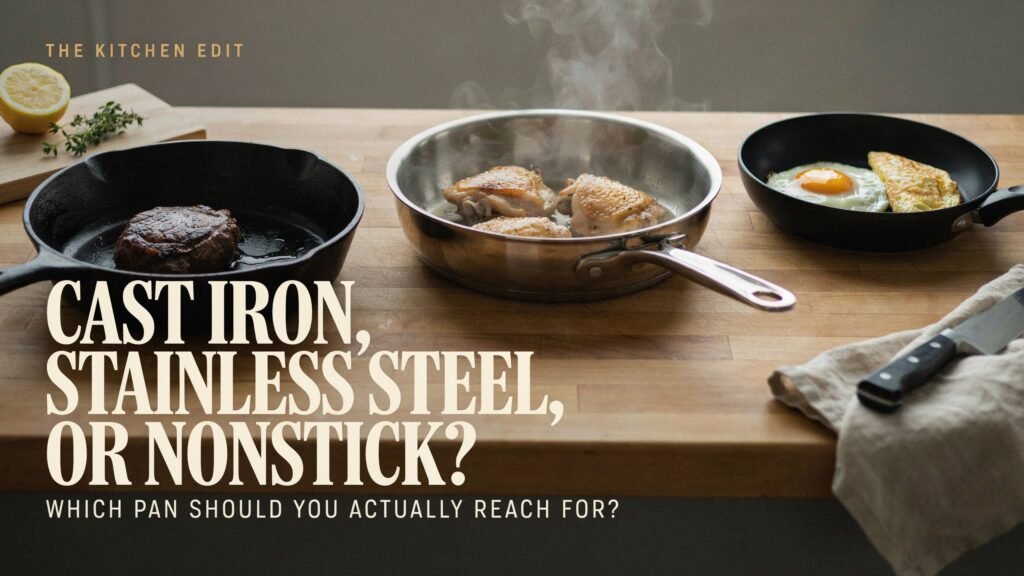
Cast iron holds and retains heat exceptionally well, which makes it excellent for searing and high-heat cooking, but that same heat retention makes it slow to warm up and slow to cool down, which isn’t ideal for anything that needs quick temperature adjustments. Stainless steel responds to heat changes quickly and builds a browned crust better than almost anything else, but it doesn’t have a nonstick surface, so it takes more attention to avoid sticking. Nonstick coatings solve sticking almost entirely, which makes them ideal for delicate food, but that same coating limits how hot the pan can safely go, so it’s not built for aggressive searing.
None of these are flaws exactly — they’re trade-offs, and every material has them. The real skill isn’t picking a favorite pan and using it for everything. It’s recognizing what a given recipe actually needs — high heat, a browned crust, gentle release, or something in between — and reaching for the material built for that.
For a side-by-side look at how different materials and collections compare on things like heat conductivity, weight, and maintenance, the collection comparison guide breaks it down in more detail than a single article can. But the short version, covered next, is this: three materials, three different strengths, and a lot less confusion once you know which is which.
Cast Iron: Best For High, Steady Heat
Cast iron’s biggest strength is heat retention. Once it’s hot, it stays hot, and it holds that heat evenly across the entire surface even when cold food hits the pan. That makes it the go-to choice for searing steak, getting a deep crust on a pork chop, or cooking cornbread that comes out with a genuinely crisp bottom. It’s also one of the few pans that moves seamlessly from stovetop to oven, which makes it useful for dishes that start with a sear and finish baking.
The same qualities that make cast iron great at high heat also come with real trade-offs. It’s slow to heat up, so it’s not the pan to reach for when you’re in a hurry or need to adjust temperature quickly. It’s heavy, which some people find tiring to maneuver, especially in a larger size. And until it’s well-seasoned, it’s not particularly forgiving with delicate foods like eggs or fish, which tend to stick more than they would in a dedicated nonstick pan. Acidic foods, like tomato-based sauces cooked for a long time, can also wear down seasoning faster than normal use.
None of this makes cast iron a bad choice — it just means it’s suited to a specific kind of cooking rather than being an everyday, all-purpose pan. For high-heat searing, roasting, and dishes that benefit from steady, retained heat, it’s genuinely hard to beat.
For anyone who wants the benefits of cast iron without doing the initial seasoning process themselves, pre-seasoned cast iron comes ready to cook with out of the box. The Bobby Flay by GreenPan cast iron frypan is another option built for exactly this kind of high-heat, stovetop-to-oven cooking.
Here’s section 4:
Stainless Steel: Best For Browning, Sauces, and Everyday Versatility
Stainless steel’s biggest strength is what happens on the surface of the pan while food cooks. As meat sears, small browned bits stick to the bottom, known as fond, and that fond is the base for pan sauces, gravies, and deglazed dishes that get a lot of their flavor from what’s left behind in the pan. Nonstick surfaces are specifically designed to prevent that kind of sticking, which is exactly why they’re not the right tool for this job. Stainless steel, without a coating in the way, does it better than almost anything else.
Beyond sauces, stainless steel is genuinely versatile. It handles a wide range of cooking, from searing to sautéing to simmering, and it responds to heat changes quickly, which makes it easier to adjust on the fly compared to cast iron. It’s also lower maintenance in a different way than cast iron or nonstick — there’s no seasoning to maintain and no coating that eventually wears out, so a good stainless pan can last for decades without needing much beyond regular cleaning.
The trade-off is that stainless steel takes more attention than a nonstick pan to avoid sticking. Getting the pan properly hot before adding oil, and giving food enough time to release naturally before trying to move it, both matter more here than they do with a coated surface. That’s not a flaw so much as the nature of the material — it rewards a bit of technique in exchange for the browning and durability it offers.
For everyday cooking that benefits from this kind of versatility, the Stanley Tucci 3-ply stainless steel collection is built for exactly this — searing, sautéing, and sauce-making in a single, durable pan meant for daily use.
Here’s section 5:
Nonstick: Best For Delicate, Low-Fat, or Sticky Foods
Nonstick’s biggest strength is exactly what its name suggests — food releases from the surface with little to no effort, which makes it the clear choice for anything that tends to tear, stick, or fall apart in a pan without that kind of help. Eggs are the classic example, but the same logic applies to fish fillets, crepes, pancakes, and anything else that’s delicate, has very little natural fat, or needs to hold its shape while cooking. In a stainless or cast iron pan, these foods demand near-perfect heat and timing to avoid sticking. In a nonstick pan, the coating does most of that work for you.
The trade-off is that nonstick isn’t built for the kind of high-heat searing that cast iron and stainless steel handle well. Most nonstick coatings are meant for low to medium heat, and pushing them too hot can shorten the coating’s lifespan over time. Nonstick also doesn’t build fond the way stainless steel does, so it’s not the right choice for dishes where a pan sauce is part of the plan. And because the coating itself is a wearable layer, it has a real lifespan — typically a few years with normal care — unlike stainless or cast iron, which can last indefinitely.
None of this makes nonstick a lesser choice, just a specialized one. For the specific job of cooking delicate or sticky food without a fight, it’s the right tool, and trying to do that same job in stainless or cast iron usually means more frustration for no real benefit.
GreenPan’s ceramic nonstick collections are built around this strength. The Valencia Pro line is a reliable everyday option, and Spectra combines the same PFAS-free ceramic coating with added durability for anyone who wants nonstick performance that holds up a little longer under regular use.
Side-by-Side: Matching Food to Pan
For a quick answer without re-reading the sections above, here’s how common foods and cooking methods line up with each material:
| Food or Method | Best Pan | Why |
|---|---|---|
| Searing steak or chops | Cast iron | Retains and holds high heat evenly for a deep crust |
| Cooking eggs | Nonstick | Delicate texture releases cleanly without tearing |
| Pan sauces and deglazing | Stainless steel | Builds fond that forms the base of the sauce |
| Fish fillets | Nonstick | Low fat and delicate texture stick easily otherwise |
| Cornbread or stovetop-to-oven dishes | Cast iron | Holds steady heat and moves safely from stove to oven |
| Sautéing vegetables | Stainless steel | Quick heat response and good browning |
| Stir-frying | Carbon steel or cast iron | High, steady heat suited to fast, hot cooking |
| Pancakes and crepes | Nonstick | Releases cleanly without tearing or sticking |
| Browning meat for stew | Stainless steel | Builds fond that deepens the flavor of the finished dish |
| Reheating leftovers gently | Nonstick | Low heat, easy cleanup, no risk of sticking |
For stir-frying and other high-heat, fast-moving cooking, GreenPan’s carbon steel frypans are worth considering alongside cast iron — they heat up faster while offering similar high-heat performance, which suits the quick pace stir-frying usually demands.
This table is a starting point rather than a strict rule. Plenty of dishes can be cooked in more than one material with good results, but when a recipe is fighting you, checking whether the pan matches the task is often the fastest way to figure out why.
Do You Need All Three?
Not necessarily, but it depends on how often you cook and what you tend to make. For someone who cooks a few times a week and sticks to a fairly simple rotation of meals, one solid nonstick pan and one stainless steel pan cover most everyday cooking — eggs, weeknight sauces, sautéing, and general stovetop meals. That combination handles the two most common frustrations, sticking and browning, without requiring a third pan just for occasional use.
Cast iron is more of an addition than a starting point. It earns its place for people who sear steak regularly, bake cornbread, or want a pan that goes from stovetop to oven without a second thought. If that’s not a regular part of how you cook, it’s reasonable to hold off and add it later rather than buying it upfront out of a sense that a “complete” kitchen requires one.
For anyone building a kitchen from scratch, buying a cookware set that combines materials is often more practical than assembling pieces one at a time. It also tends to be more cost-effective than buying each pan separately later. For a more tailored starting point based on how you actually cook, the product finder quiz walks through a few quick questions and points toward collections that fit, rather than guessing.
The honest answer is that all three materials are useful, but usefulness isn’t the same as necessity. Start with what covers your actual cooking habits, and add from there as gaps show up, rather than assuming a full set of three is the baseline everyone needs.
Closing
Cast iron, stainless steel, and nonstick aren’t really competing with each other, even though they often get compared like they are. Each one is built for a different kind of cooking, and most of the frustration people run into in the kitchen — food sticking, a crust that won’t form, a pan that takes forever to heat up — comes down to using the wrong material for the job rather than a flaw in the pan itself.
The good news is that once you know what each one is actually good at, the decision stops requiring much thought. Reach for cast iron when you need high, steady heat. Reach for stainless steel when browning and fond matter. Reach for nonstick when the food is delicate and sticking is the main thing you’re trying to avoid. That’s most of the decision, right there.
For anyone looking to round out what’s currently in their kitchen, the collection comparison guide is a useful next step — it lays out GreenPan’s collections side by side so it’s easier to see exactly which gap a new pan would actually fill.